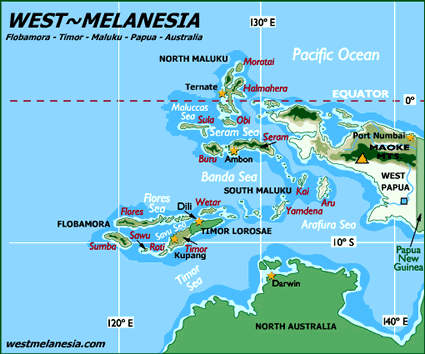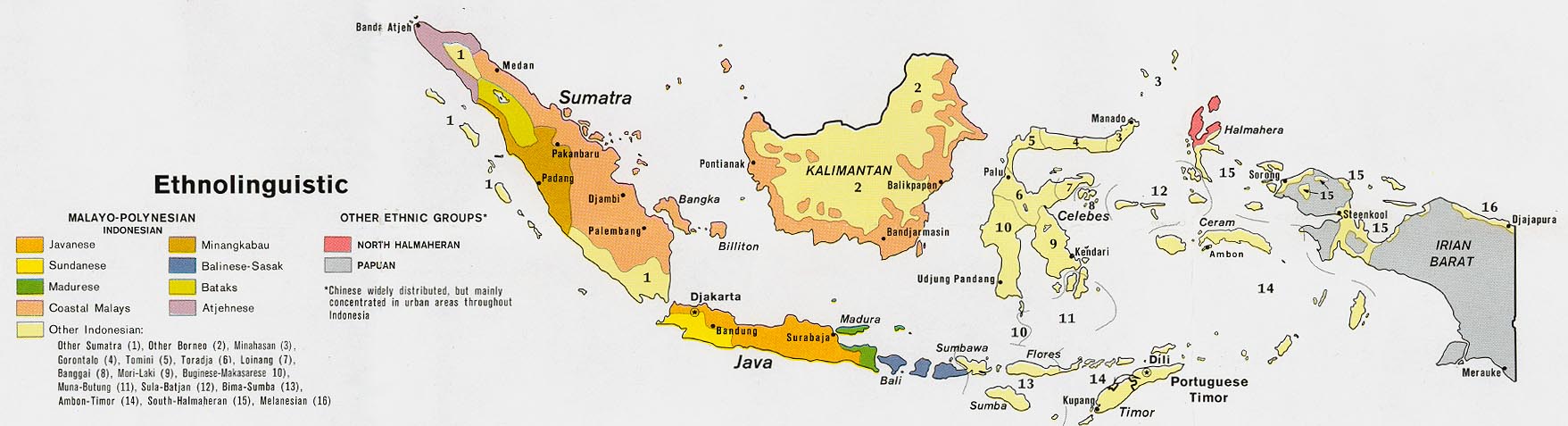
The Te'un people are associated with the clustering of small volcanic islands in the southwestern Maluku region of Indonesia — specifically the islands of Teun (also spelled Te'un), Nila and Serua, which form part of the inner Banda Sea arc. Over time, the community was displaced and resettled on the larger island of Seram due to volcanic and development?driven relocation policies.
Linguistically, the Te'un (or Teun) language was originally spoken on Teun Island (in villages such as Mesa, Yafila and Wotludan) and on Nila Island (in Bumei village). It is an Austronesian language grouping (Teun–Nila–Serua) of the Southwest Maluku region. The language is now classified as extinct, or nearly so. Younger generations have shifted to Ambonese Malay and Indonesian, and few fluent speakers remain.
Historically, the islands were involved in the nutmeg trade and other archipelago?wide networks of exchange; in the 17th century, the Dutch East India Company removed nutmeg trees from Nila and Serua in order to monopolize the spice trade.
In 1978 the Indonesian government implemented a relocation of the island?community to a settlement in Waipia on Seram Island, which created social and cultural changes.
Members of the Te'un community now live in villages in the Waipia area of Seram Island (Central Maluku Regency), having been settled there following their relocation from the smaller islands.
Their livelihood is now a mixture of fishing, small?scale agriculture, and labor in more settled contexts—though relocation has meant that customary land rights, traditional fishing grounds and island identity have been disrupted.
Families often face difficulties adapting to the farming and work culture of the mainland, compared with their prior island-based life, and sometimes remain dependent on seasonal returns to the former islands for certain harvests or marine resources.
Social networks and traditions that once centered around the small island village life have been eroded by geographic displacement, modernization, migration, and the shift toward the Indonesian national language and education systems.
In the wider Maluku region, the dominant religions are Christianity (especially Protestantism) and Islam, with many island communities historically following Christianity alongside residual animist/customary faiths.
For the Te'un?Nila?Serua grouping there is limited published data on the specific religious beliefs of the people. However, given their settlement in Maluku and patterns of Christian missionary influence across the islands, it is likely that Christianity (especially Protestant) is the major organized religion. The shift away from ancestral island languages and traditions suggests that many of the older animist or traditional practices have diminished. At the same time, the forced resettlement and social change have tended to weaken the continuity of traditional belief systems and place a greater reliance on Christian institutions and the Indonesian national faith structure.
Because of this transition, a portion of the community may continue to hold customary beliefs about ancestors, spirits, or land?based ritual, but these are less documented and not widely affirmed in written sources.
The Te'un people face a number of needs tied to language preservation, cultural identity, economic stability, and spiritual engagement. Because their original language is essentially extinct, there is a need for documentation and revitalization efforts to preserve cultural heritage and give younger generations access to their ancestral linguistic identity.
Due to relocation and adaptation to a new environment on Seram Island, the community needs sustainable livelihood strategies that align with their traditional knowledge of island fishing and maritime resources and are adapted to their mainland residence context.
Educational opportunities in both the national language, Indonesian, and local languages, combined with culturally relevant schooling, would help younger people gain skills while maintaining their identity.
Given that religious outreach among the Te'un is relatively limited and the community may still be under?reached by evangelical Christian ministry, there is a need for culturally appropriate Christian witness, discipleship, and church?planting efforts that respect and incorporate the community's background and experiences of displacement.
Finally, social cohesion and community infrastructure require strengthening. Land rights from relocation remain unresolved in some cases, and community solidarity has been under pressure from modernization and migration, so support for community development, leadership training, and locally?led initiatives is beneficial.
Pray that unresolved land and resettlement issues would be healed, that the community would gain secure rights and peace in the places they live.
Pray for local churches and Christian workers to engage sensitively and effectively with the Te'un community, offering hope, discipleship, and a contextualized gospel message.
Pray for the Te'uns to disciple others, including Muslims.
Pray that younger Te'uns would develop a faith in Christ, and that generational gaps would be bridged through mentoring, education, and inter-generational dialogue.
Scripture Prayers for the Te'un in Indonesia.
Edwards, Owen. "Teun, Nila, and Serua (Indonesia) – A Collection of Language Snapshots." Language Documentation and Description, vol. 25, no. 1, 2025.
lddjournal.org
van Engelenhoven, Aone. "Language Endangerment in Indonesia: the Incipient Obsolescence and Acute Death of Teun, Nila and Serua (Central and Southwest Maluku)." In M. Janse & S. Tol (eds), Language Death and Language Maintenance: Theoretical, Practical and Descriptive Approaches, John Benjamins, 2003.
Litaay, Simona C. H.; Agustang, Andi; Syukur, Muhammad. "Policy of Teon Nila Serua Community Settlement Program in Waipia, Central Maluku." Jurnal Manajemen Pelayanan Publik, vol 6, no 2, 2023.
ResearchGate
"Teun language." Wikipedia.
"Indonesia: Languages, Literacy, & Maps." Ethnologue.
| Profile Source: Joshua Project |